
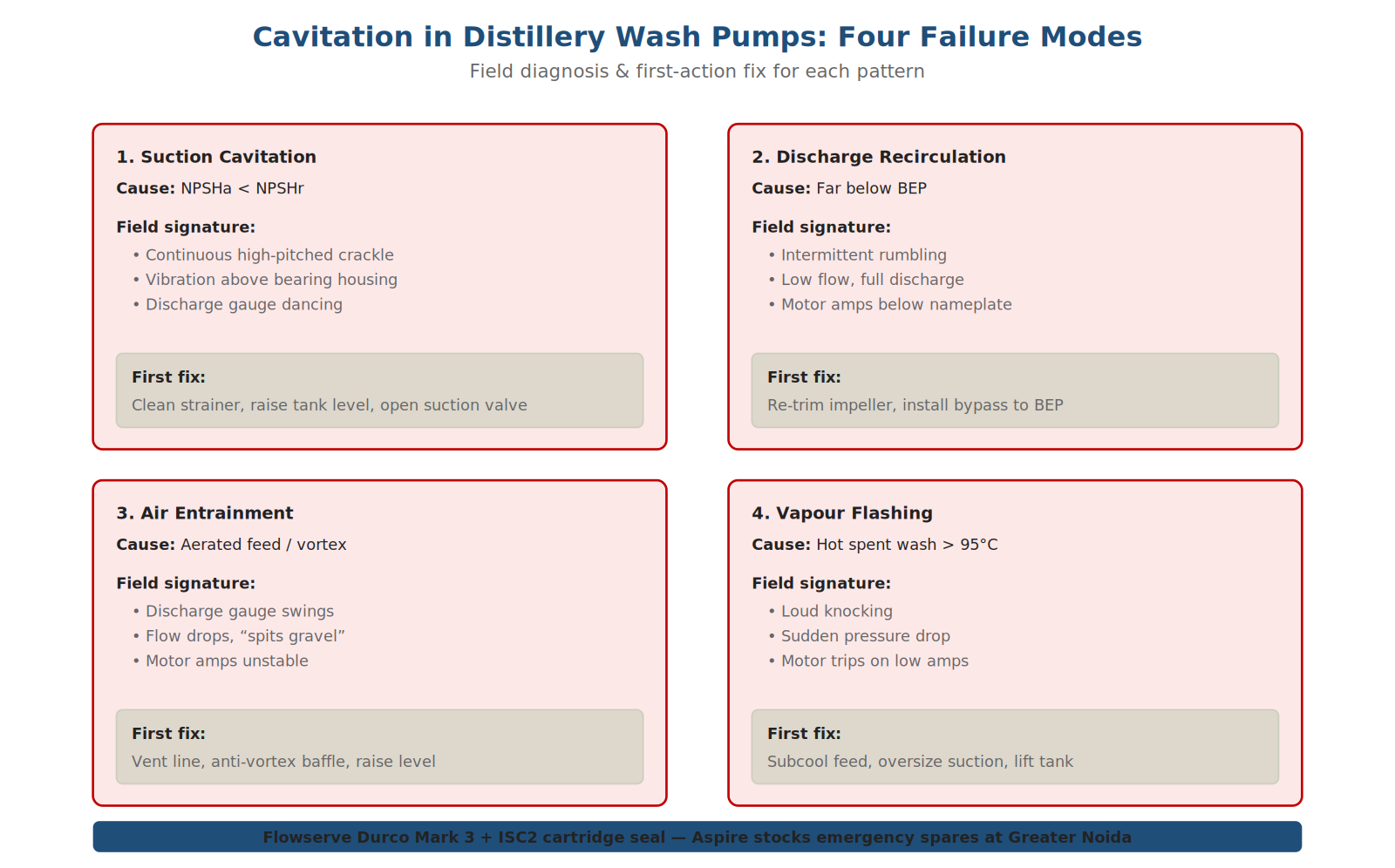
Figure 4 — Four cavitation failure modes in distillery wash pumps
The cost of a tripped wash pump
A wash pump trip in a 200 KLPD grain distillery shuts down fermentation feed within minutes. Cascading consequences include yeast die-off in the fermenter, off-spec batch product, missed loading-tanker schedules, and 6–24 hours of lost production worth ₹15–60 lakh. The first job of the shift engineer is to confirm whether the trip is mechanical, electrical, or hydraulic — and if it is cavitation, fix it before the seal goes.
The four wash-side pump failure modes
1. True suction cavitation (NPSHa < NPSHr)
The pump’s available NPSH (NPSHa) has dropped below what the pump needs (NPSHr). Causes:
- Tank level dropped below the level used for original NPSHa calculation
- Suction strainer is choked with grain husk or yeast solids
- Suction valve is partially closed
- Fluid temperature has risen, dropping the available margin
- Suction piping has air pockets (poor commissioning, high spots)
Field signature: continuous high-pitched crackling sound, vibration above bearing housing, pressure-gauge needle dancing, motor amps below nameplate.
2. Discharge recirculation
The pump is running far below its best efficiency point (BEP). At low flow, fluid recirculates inside the impeller, causing localised low-pressure zones and vapour bubble collapse.
Field signature: intermittent rumbling, low flow, full discharge pressure, motor amps below nameplate.
3. Air entrainment from yeast propagation
Aerated fermenter feed, CO₂ flash from warm dunder, or vortexing at low tank level pulls air into the pump.
Field signature: discharge gauge swings, flow drops, pump sounds like it is “spitting gravel”.
4. Vapour flashing on hot spent wash
Spent wash from the bottom of the distillation column can be 95–100 °C. Any throttling on the suction line, any height drop, or any heat soak into the line causes the fluid to flash into vapour.
Field signature: loud knocking, sudden pressure drop, motor trips on low amps.
How to confirm cavitation vs misalignment vs bearing failure
A 2-minute checklist:
| Symptom | Cavitation | Misalignment | Bearing failure |
|---|---|---|---|
| Vibration spectrum | Broadband, 1–10 kHz | 2× run speed | 1× run speed + bearing frequencies |
| Sound | Gravel / crackling | Hum | Whine or grind |
| Discharge pressure | Unstable | Stable | Stable |
| Motor amps | Below nameplate | Normal | Slightly elevated |
| Bearing temperature | Normal initially | Elevated | High |
If the diagnosis is cavitation, the next decision is whether to do a system-side fix (suction piping, tank level) or a pump-side fix (impeller trim, seal upgrade).
Why Flowserve Durco Mark 3 ANSI is the wash-side standard
Most Indian distilleries built since 2010 have standardised on the Flowserve Durco Mark 3 ANSI process pump for wash, dunder and spent-wash duty. The reasons:
- Open or semi-open impeller clears grain husk, fibre and yeast solids without choking
- CD4MCuN duplex stainless casing resists chloride attack from spent wash
- API Plan 32 ready — easy external flush for sticky fluids
- Spare-part standardisation across the 1.5×1×6 to 6×4×17 size range
- Genuine Flowserve seals available in cartridge formats that drop in without specialist tooling
Impeller variants worth knowing
- Group 1 / Group 2 / Group 3 — bigger groups handle higher flow at lower head
- Open vs semi-open — open for high-solids (filter cake, mud); semi-open for cleaner wash
- Recessed-impeller variant — for the very thickest dunder or vinasse
Mechanical seal selection for wash, dunder and spent wash
Wash, dunder and spent wash are sugary, abrasive, sometimes-hot, and PESO-classified hazardous when ethanol is present. The seal choice drives most of the MTBF.
Single vs double seals
- Single cartridge seal with API Plan 32 (clean external flush) — standard for ambient wash and dunder
- Double seal with API Plan 53A — for hot spent wash above 85 °C and any ethanol-bearing service inside the hazardous zone
Flowserve ISC2 vs BX
- Flowserve ISC2 — universal cartridge, balanced, FKM elastomers, SiC × carbon or SiC × SiC faces. Default choice for most wash services.
- Flowserve BX — heavy-duty bellows for hot syrup, concentrated dunder, and spent wash. Resists chemical attack from caustic CIP cycles.
Quick-win retrofits when the pump is already in place
Before ordering a new pump, try these in sequence:
- Clean the suction strainer and confirm it is open
- Verify tank level is above the NPSHa design value
- Open the suction valve fully, then check that the valve actually opens (broken stem is a common defeat)
- Vent the suction line at high points
- Re-trim the impeller to move the BEP closer to the operating point
- Increase suction piping diameter by one nominal size
- Add an external flush (API Plan 32) to extend seal life while the upstream fix is being designed
Recommended spare-parts kit per wash pump
Hold one set per installed pump:
- Impeller and key
- Casing wear ring and impeller wear ring
- Shaft sleeve
- Cartridge mechanical seal (one ISC2 + one spare gasket set)
- Bearing pair (deep groove + angular contact)
- Bearing housing gaskets and O-rings
- Coupling spider
Aspire Solution stocks the Durco Mark 3 wear-part and seal kit at Greater Noida.
Service options — Aspire’s Flowserve seal replacement service
We offer scheduled on-site seal replacement, pre-season pump overhaul, and emergency 24-hour seal supply across UP, Punjab, Bihar, Uttarakhand and NCR. Service is delivered by Flowserve-trained technicians using genuine seal kits.
Preventive maintenance checklist
A short downloadable checklist for shift handover includes vibration trending, bearing temperature trending, discharge pressure logging, seal flush flow check and CIP cycle compliance. We share the PDF on request — drop a note to enquiry@aspiresolution.in.
When to RFQ a replacement pump
Replace rather than rebuild when any two of the following are true:
- Casing wear is beyond Flowserve allowable limit
- Pump has had three or more seal failures in 12 months despite correct piping
- Operating point has shifted >25% from original BEP
- Hydraulic performance is more than 15% below curve
Send the existing pump nameplate plus current duty to enquiry@aspiresolution.in or WhatsApp +91-9958928056 for a like-for-like or upgraded Flowserve quote.
