
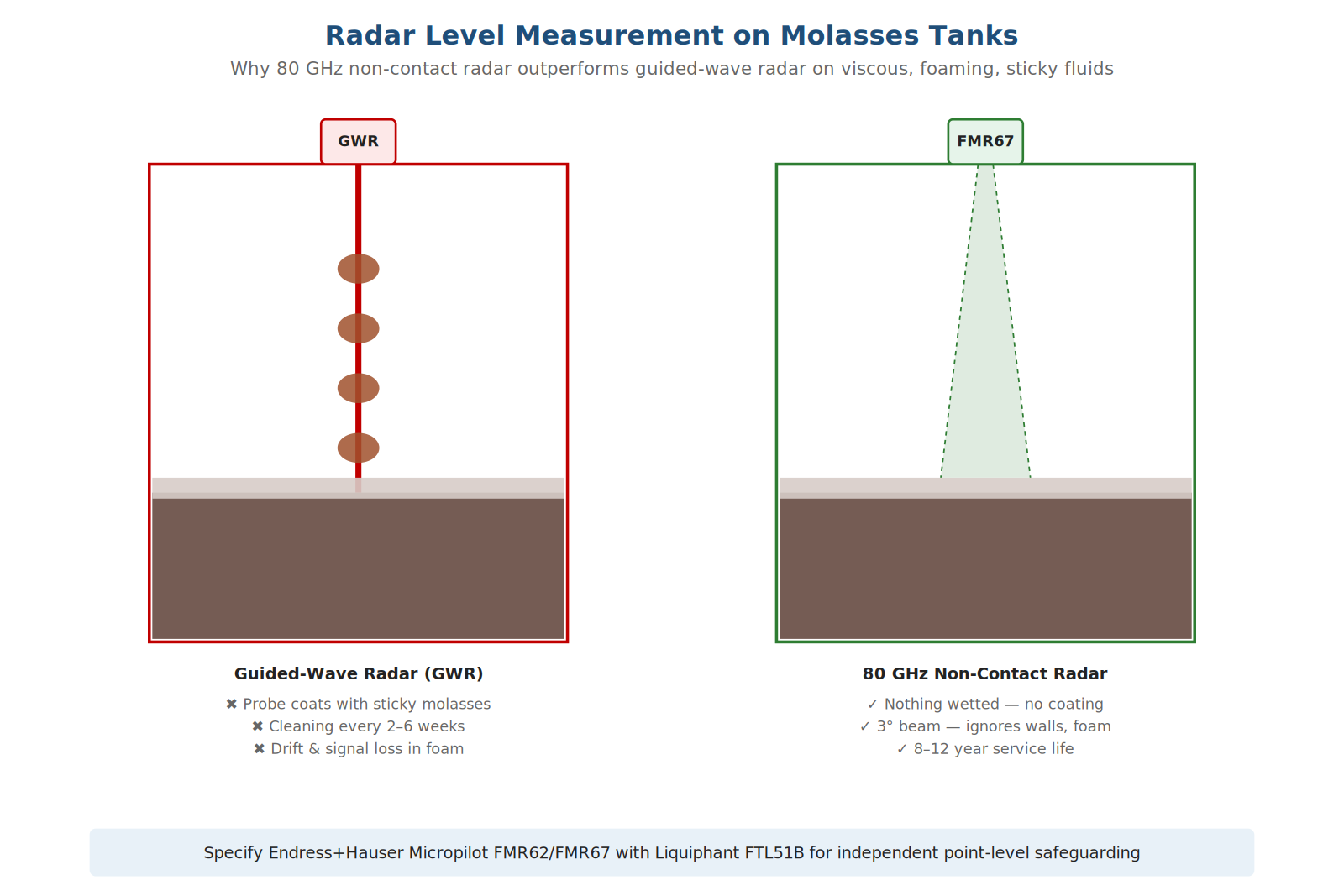
Figure 3 — Why 80 GHz non-contact radar outperforms guided-wave radar on molasses
Why molasses is one of the hardest level-measurement applications
Molasses level measurement defeats most generic level instruments. The fluid has all the worst properties at once:
- Viscosity typically 5,000–10,000 cP at storage temperature, rising sharply when the tank cools
- Stickiness and coating — molasses builds up a thick crust on any wetted instrument
- Foam from dissolved CO₂ and fermentation carryover when the tank receives fresh charge
- Density swing with Brix — a 78 Brix B-heavy will differ from a 92 Brix final molasses
- Temperature ranges from 30 °C in storage to 80 °C+ during transfer
- Dark colour that interferes with optical and laser-based devices
A bad instrument choice in this service is not a minor annoyance. It causes tank overflows (a serious safety and environmental incident), or it causes the distillery to run out of feedstock mid-fermentation.
Why guided-wave radar fails on heavy molasses
Guided-wave radar (GWR) measures by sending a microwave pulse down a rod or rope probe. In molasses service, the probe rapidly accumulates a sticky coating that absorbs and reflects the signal in unpredictable ways. Field reports from UP sugar mills indicate GWR probes in molasses tanks need cleaning every 2–6 weeks, and even with cleaning the measurement drifts.
Why ultrasonic and DP also fail
Ultrasonic level transmitters require a clean air gap between the sensor and the fluid surface, but foam in molasses tanks absorbs the ultrasonic pulse. Differential pressure (DP) measurement requires a stable, known density — but molasses density varies with Brix, temperature and air entrainment. Both approaches are routinely abandoned in distillery storage tanks after the first foaming-related overflow incident.
Non-contact 80 GHz radar — the right answer
80 GHz non-contact radar (FMCW) sends a microwave frequency-modulated signal from the tank top, measures the round-trip time, and computes level. Three properties make 80 GHz uniquely suited to molasses:
- Narrow beam angle (around 3°) — the beam ignores tank walls, ladders and agitator shafts
- High signal dynamic range — sees through foam and vapour
- Non-contact — nothing wetted, no coating, no cleaning
Endress+Hauser Micropilot FMR6x
The Micropilot FMR62 and FMR67 are the workhorses for molasses service in India. Key selection criteria:
- Antenna size — 80 mm or 100 mm for tanks above 15 m diameter
- Process connection — flanged, with extension nozzle suited to vapour-space length
- Material — 316L wetted parts; PEEK or PTFE antenna lens for chemical compatibility
- Communication — HART + 4–20 mA for DCS integration; PROFIBUS PA for fieldbus installations
- Heartbeat Technology — built-in diagnostic that flags coating, foam or beam obstruction
Tank-side mounting and nozzle selection
The nozzle must be large enough that the radar beam does not reflect off the nozzle wall. A rough rule: nozzle diameter must be at least 0.7× the antenna diameter, and the nozzle height should not exceed twice the diameter. The radar should be mounted away from the inlet/outlet streams and away from the agitator shadow.
Point-level safeguarding with Liquiphant FTL51B
Independent of the radar, every molasses tank should have a high-high level point switch wired directly to the inlet valve interlock. The Endress+Hauser Liquiphant FTL51B with PFA-coated tuning fork is the standard choice for molasses. PFA prevents stick-on; the tuning-fork principle is unaffected by foam, viscosity or density swings.
Hazardous-area considerations
If the molasses tank is part of the distillery hazardous zone (Zone 1 or Zone 2 under Petroleum Rules 2002), both the Micropilot and the Liquiphant must carry valid PESO/CCoE certification along with ATEX/IECEx Ex d or Ex ia approval. We cover the full hazardous-area instrument scope in our PESO instrument guide.
Wiring, HART, 4–20 mA, Heartbeat verification
For most installations, two-wire 4–20 mA + HART is sufficient. Specify:
- HART revision 7 for full diagnostic data
- Heartbeat verification — annual loop test without removing the transmitter
- Loop power from the DCS analog input card (24 V DC, 22 mA typical)
- Surge protection for tank-top installations
- Cable gland and conduit suited to outdoor service
Total installed cost vs MTBF — a typical UP distillery example
For a single 1,000 KL molasses storage tank in a UP distillery:
| Solution | Hardware cost (₹ lakh) | Annual maintenance | Replacement cycle |
|---|---|---|---|
| Ultrasonic | 0.6–1.0 | High (manual checks) | 2–3 years |
| Guided-wave radar | 1.5–2.5 | Medium (cleaning) | 3–5 years |
| 80 GHz Micropilot + Liquiphant | 3.5–5.0 | Low (zero contact) | 8–12 years |
Over 8 years the 80 GHz solution typically delivers lower total cost of ownership while eliminating the overflow-risk hazard.
Aspire Solution as the E+H channel partner
Aspire stocks Micropilot and Liquiphant in the most-specified configurations for sugar and distillery service. Wet calibration, hazardous-area certification, and on-site commissioning are part of standard supply.
FAQs
Q. Can the Micropilot handle 92 Brix final molasses? A. Yes. 80 GHz radar is largely indifferent to dielectric constant variation in this Brix range.
Q. What about agitated tanks? A. Mount the radar 0.5–1.0 m from the tank wall, outside the agitator shadow. A still-pipe is rarely required at 80 GHz.
Q. Retrofit on an existing tank — what nozzle do I need? A. Send tank GA drawings to enquiry@aspiresolution.in. We will check beam geometry and recommend nozzle size or a flanged adapter plate.
